Safety & Warnings
Electric Towel Rails must be installed by a licensed electrician in accordance with the current IEE wiring regulations. The product should be permanently fixed and connected to the 220/240 Volt AC mains power supply via a fused spur/cable outlet, and earth bonded. This product is a Class 1 unit and as a result it must be earth connected. The element must NEVER be used without the towel rail or radiator being filled with water or fluid at correct fluid level. Only use the device in a suitable towel rail or radiator, for space heating and/or towel drying. This element should be mounted vertically and in the BOTTOM of the towel rail; it can be mounted horizontally only when it is in the ambient temperature control mode. It is imperative that you have the correct fluid level (90% fluid of towel rail total volume is recommended) in the towel rail before the element is used. Never attempt to disconnect the control unit from the heating element. It is a unit that was factory-sealed. Ensure the O-ring is on the connection part before installation; this o-ring is preventing the leakage after installation. Always use the correct tools (Spanner). Comes with Cable Cover.
Useful Features
Boost mode – If you need a short boost Maximum heating performance, then press the button on the control unit, boost time option is 2 and 4 hours. The element will stay working at the setting boost hours at maximum performance. After heating at the setting hours, it will revert back to previous chosen mode and temperature.
Over heated protection – If the automatic control system is faulty and the water temperature in the radiator is increasing in an uncontrolled manner, the system has two safety mechanisms to prevent excessive pressure in the radiator. Firstly, the entire system is completed shut down electronically when a water temperature of 95°C is reached. If this protection mechanism fails for whatever reason, a simple downstream thermal fuse ensures complete shut-down
Freeze protection – Once the control unit is in “STANDBY” mode (Power on), The control unit has an automatic freeze-protection setting. The default setting for frost protection is between 7°C and 15°C. If the radiator temperature falls below 7°C,the heating system switches on automatically, heats the liquid in the radiator to 15°C and then switch off again. An Ice symbol appears on the display.
Room temperature compensation – As the NTC that measures the room temperature and feeds back information to the controller is located on the back of the controller, it is close to the warm radiator. The measured temperature will therefore not accurately reflect the temperature in other part of the room. For this reason, there is an automatic temperature adjustment of -3°C in the control unit.
Open window/open door detection – This automatic function detects when the temperature falls by 2°C or more over a short period of time. In this case, the system assumes that this reduced temperature is due to opened windows or open doors, “OP” will be displayed on the controller unit and the heating system is switched off automatically and will be active to heat automatically once the temperature is detected back to stable condition.
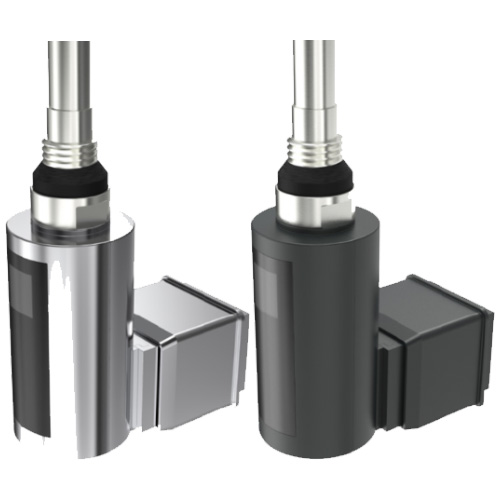
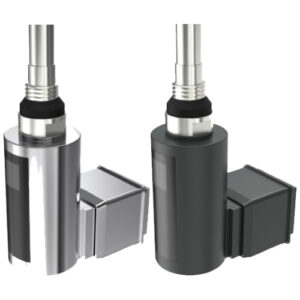
Note: The image above shows both the chrome and the anthracite models – this listing is for the ANTHRACITE model.

Established in 2005 and still privately owned, REINA continues to innovate and create more products than any other company in this field and with some tremendous features, energy efficiency and outstanding designs. The immense variety of sizes, shapes and styles of radiators allows for a plethora of choice in relation to functionality and looks, fitting in with any interior no matter how simple or unique it might be. It is a pleasure to be an exclusive supplier of Reina Radiators and we know you will be delighted with a product that does more than just add warmth.
There are a variety of factors which influence the BTU (British Thermal Unit) required to effectively heat a room and therefore can influence significantly the number of radiators required and the size and other specifications of those radiators. This form of measurement relates to what is considered to be an older imperial calculation, whereas Watts is a more modern internationally recognised form of measurement.
All radiators have a stated BTU which gives customers an indication of the heat output. If you have a particularly large area to heat, you could choose to have one large radiator or two or more smaller radiators. The number of radiators more than often depends on the availability of wall space that you are prepared to be used.
Below are some examples as to the BTU output required to heat rooms (in the calculation it is assumed that these rooms are double glazed) - but there are a lot of variables involved, so remember this is only a general guide.
- Lounge/Dining Room 5m (L) X 5m (W) X 2.5m (H) 8400 BTU (2460 Watts), giving you between 20-22°C.
- Bathroom 2.5m (L) X 2.5m (W) X 2.5m (H) 2000 BTU (585 Watts), giving you between 19-21°C.
- Bedroom 4.5m (L) X 4.5m (W) X 2.5m (H) 5400 BTU (1580 Watts), giving you between 18-20°C.
- Kitchen 4m (L) X 4m (W) X 2.5m (H) 3200 BTU (935 Watts), giving you between 19-21°C.
When comparing BTU ratings for radiators from different suppliers, you must always see if they are using the same Delta Rating. Delta Ratings are used by all manufacturers and suppliers of radiators and are commonly identified as Delta T50, T60 or T70. If the Delta rating is the same for each radiator, then you can directly compare heat outputs, if not you must convert them to the same Delta Rating to accurately compare.
In calculating the BTU of any Reina radiator, they use the industry reference and calculation relating to the 'Delta T70' rating - so if you want to compare the output of Reina radiators to the output of other manufacturers radiators who employ the reference 'Delta T60', then simply divide the BTU we provide by 1.223 or divide by 1.545 for 'Delta T50'; more about this in a minute.
Each Delta rating uses temperatures of both the boiler water and the room in which the radiator is located. For example, the use of the reference 'Delta T60' assumes that the temperature of the water going out of the boiler is 90 degrees and returning into the boiler at 70 degrees; therefore averaging 80 degrees. The industry then assumes that the average temperature of a room in which the radiator is located is about 20 degrees. The figure 60 (from T60) comes from subtracting the average room temperature from the average temperature of the water as it flows through the system (80 minus 20).
Reina uses the industry reference 'Delta T70' assuming that the temperature of the water is potentially higher than this and leaves the boiler at 100 degrees and returns into the boiler at 80. So here, the figure 70 comes from subtracting the average room temperature from the average temperature of the water as it flows through the system (90 minus 20).
Some companies use the reference 'Delta T50'; from the above examples you can work out where the figure 50 comes from.
It should be noted that Watts are not changed by this and should always be consistent between radiators no matter what BTU rating is used.
As is quite common with products of this nature, they come with a lot of technical jargon, so here is a brief guide.
What are 'Pipe Centres': this term relates to the distance (in mm) between the centre of the pipe attached to the radiator via a 90 degree join (the vertical pipe that takes the water into and out of the radiator) from the left side to the centre of the vertical pipe that protrudes out of the right side of the radiator via a 90 degree join. Sometimes it can be the same as the width of the radiator specified by the manufacturer (where the pipe goes straight into the underside of the radiator on each side), but it all depends on where those pipes are located. We recommend leaving a minimum clearance of about 200mm either side of the radiator to any fixings or other objects.
What does 'Wall to Pipe Centres' mean: this term simply relates to the distance between your wall and the centre point of the vertical pipe that takes the water into and out of the radiator. Do not be concerned by the location of the skirting board, as the radiator will be fixed above, giving ample clearance. Therefore, the location and width of the skirting board has no effect on this distance.
What is meant by 'Wall Distance': this term relates to the distance between your wall and the front of the radiator.
What are the different 'Fuel Types': some radiators are designed specifically to be connected to a central heating system (boiler); others are stand alone radiators with a built-in fixed electric heating element, while some are Dual purpose where both of these options are available.
What are the different metals that are used in manufacturing radiators: there are three principle materials, mild steel, stainless steel and aluminium. Powder coated colouring is available on some models to match the interior décor and aesthetics of your living space.








Reviews
There are no reviews yet.